Historisch
Event-Karte
Nur Englisch
Schlafplatz
Vollpension
Alle Einrichtungen
Fučíkova, Terezín, okres Litoměřice, Ústí nad Labem Region, 411 55, Czechia
Requiem: Reichskinder provides an opportunity to experience the depressing environment of the fictional Rehabilitation Institute for Problematic Youth through a personal story of being uprooted, searching for one’s identity, and coping with one’s past. Our goal is to bring to light the complicated stories of people living their lives in the grey zone between Czech and German nationalities, stories of young people whose lives were changed dramatically during the war and whose troubles not only failed to vanish with the end of the war, but often got worse or only then truly began. Alternatively, players can become members of the Institute’s staff: Czechoslovaks who had often experienced the war firsthand and had to take an attitude towards the pupils in the Institute.
We provide a dark, atmospheric content game offering an intense experience, as well as a strong story that is developed during the game primarily by the players themselves, who are provided with strong techniques to do so. Our goal is NOT to create an authentic reconstruction of period realities or educational practices. The discomforting enviornment and strict schedule of the Institute serve as atmospheric tools that form the common framework of all the characters’ individual destinies. Our aim is by no means to physically harass the players or to test their abilities and boundaries. At the same time, it feels appropriate to emphasize that the game deliberately works with psychological deprivation, oppression, and restriction of freedom. The game also purposefully operates by blurring the common objective reality of the characters using a number of tools that allow players to develop their stories in a personalized way. Neither psychological deprivation nor oppression, nor restriction of freedom, nor our narrative tools (see “Drama Therapy,” “Therapeutic Procedures,” etc.) should be considered a goal of this game. Our goal is to create a powerful story, and all these methods must serve that story.
The game is set in 1945, but it is only loosely inspired by some of the real events of that time, and it is not a historical reenactment. We use selective historical facts, and our intention is to tell the stories of people, not to present a portrayal of that period. At the same time, all the characters are fictional, their plots only loosely representing the destinies of the actual children of their time, and they are often presented in a concentrated, intense, pushed-to-the-extreme form. In addition, in order to focus on the main themes of the game, some other possible themes had to be superseded; for example, religion is of no importance in the game.
The stories of the characters take place within the walls of the fictional rehabilitation institute, which is represented by the military hospital in Theresienstadt. A significant element of the game is the strict discipline of pupils and the consistent adherence to their regular daily routine. The game time is divided into several units that have a clearly defined schedule for blocks of activities, rest, therapies, and sleep. The pupils attend regular sessions with the therapists and undergo drama therapy and other, more drastic therapeutic procedures if necessary. Within the game, the element of repetition is essential; the stories of characters move forward and develop by repeating the seemingly identical activities that are in fact gradually moving somewhere or being put into new frames. The possible blurring or distorting of the players’ orientation in time as well as light sleep deprivation are recognized elements of the game. You will be familiarized with the entire game schedule from the beginning, and as players you will also know the approximate moments when the most important decisions should be made so that you can adjust the story of your character accordingly. The game environment is often bizarre and visually disturbing and uses various musical and light effects.
The game is of the touching type, which means that lighter forms of intimacy and violence are role-played in quite a realistic way, 1:1, game to reality—an embrace is an embrace, a kiss is a kiss, a brawl is a brawl. At the same time, during the introductory workshops before the game, all players can state and set their limits—the violence and intimacy borderlines they are not willing to cross within the game—and others must respect that limit. We also use a variety of other means to create a safe enough environment (see the design document for details).
Requiem: Reichskinder provides an opportunity to experience the depressing environment of the fictional Rehabilitation Institute for Problematic Youth through a personal story of being uprooted, searching for one’s identity, and coping with one’s past. Our goal is to bring to light the complicated stories of people living their lives in the grey zone between Czech and German nationalities, stories of young people whose lives were changed dramatically during the war and whose troubles not only failed to vanish with the end of the war, but often got worse or only then truly began. Alternatively, players can become members of the Institute’s staff: Czechoslovaks who had often experienced the war firsthand and had to take an attitude towards the pupils in the Institute.
We provide a dark, atmospheric content game offering an intense experience, as well as a strong story that is developed during the game primarily by the players themselves, who are provided with strong techniques to do so. Our goal is NOT to create an authentic reconstruction of period realities or educational practices. The discomforting enviornment and strict schedule of the Institute serve as atmospheric tools that form the common framework of all the characters’ individual destinies. Our aim is by no means to physically harass the players or to test their abilities and boundaries. At the same time, it feels appropriate to emphasize that the game deliberately works with psychological deprivation, oppression, and restriction of freedom. The game also purposefully operates by blurring the common objective reality of the characters using a number of tools that allow players to develop their stories in a personalized way. Neither psychological deprivation nor oppression, nor restriction of freedom, nor our narrative tools (see “Drama Therapy,” “Therapeutic Procedures,” etc.) should be considered a goal of this game. Our goal is to create a powerful story, and all these methods must serve that story.
The game is set in 1945, but it is only loosely inspired by some of the real events of that time, and it is not a historical reenactment. We use selective historical facts, and our intention is to tell the stories of people, not to present a portrayal of that period. At the same time, all the characters are fictional, their plots only loosely representing the destinies of the actual children of their time, and they are often presented in a concentrated, intense, pushed-to-the-extreme form. In addition, in order to focus on the main themes of the game, some other possible themes had to be superseded; for example, religion is of no importance in the game.
The stories of the characters take place within the walls of the fictional rehabilitation institute, which is represented by the military hospital in Theresienstadt. A significant element of the game is the strict discipline of pupils and the consistent adherence to their regular daily routine. The game time is divided into several units that have a clearly defined schedule for blocks of activities, rest, therapies, and sleep. The pupils attend regular sessions with the therapists and undergo drama therapy and other, more drastic therapeutic procedures if necessary. Within the game, the element of repetition is essential; the stories of characters move forward and develop by repeating the seemingly identical activities that are in fact gradually moving somewhere or being put into new frames. The possible blurring or distorting of the players’ orientation in time as well as light sleep deprivation are recognized elements of the game. You will be familiarized with the entire game schedule from the beginning, and as players you will also know the approximate moments when the most important decisions should be made so that you can adjust the story of your character accordingly. The game environment is often bizarre and visually disturbing and uses various musical and light effects.
The game is of the touching type, which means that lighter forms of intimacy and violence are role-played in quite a realistic way, 1:1, game to reality—an embrace is an embrace, a kiss is a kiss, a brawl is a brawl. At the same time, during the introductory workshops before the game, all players can state and set their limits—the violence and intimacy borderlines they are not willing to cross within the game—and others must respect that limit. We also use a variety of other means to create a safe enough environment (see the design document for details).
Your suggestions were correctly added! Hurrah!
Sie werden von den Moderatoren geprüft. Vielen Dank im Voraus!
Fučíkova, Terezín, okres Litoměřice, Ústí nad Labem Region, 411 55, Czechia
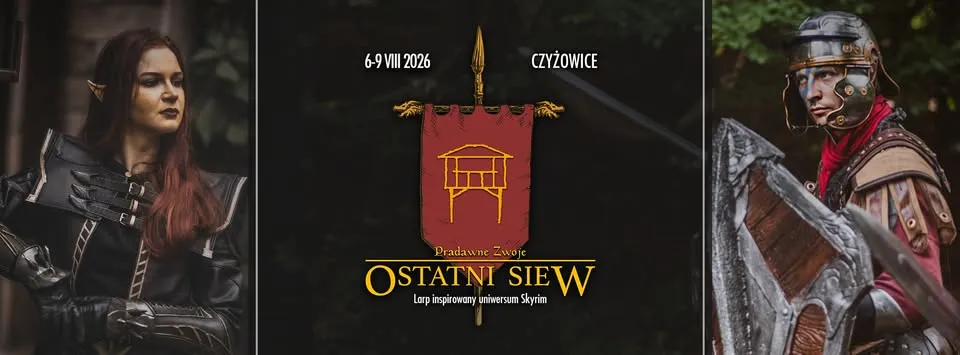
Pradawne Zwoje - larp w świecie Skyrim
Melde dich an, um das Event zu bewerten